Finding Focus
Designing an AI tool around people, not conversations
What Wendi is. A desktop AI coaching tool for managers. Meeting recording, transcription, and HR-safe guidance on difficult people situations, grounded in UK employment law.
What I did. I was the only designer and the only researcher. I designed, ran, and synthesised 40+ interviews (while the CEO led the conversations). I narrowed our customer from technical leaders to HR managers, designed the IA that replaced a flat chat interface, and reframed the product from chat-first to people-first.
Outcome. Two design partners converted from free trial to paying annually. PostHog showed daily return to the People home and the Inbox, the two surfaces the redesign introduced.
"I need to fire someone. Can you tell me the steps?"
Managers don't know how to have this conversation. An entire industry exists to answer the phone when they finally ask.Wendi started as a broad HR chatbot that tried to fill that HR consultancy gap. As the founding designer in a team of six, that meant I also did research, product strategy, pricing, and sales decks.
"How is this different from ChatGPT?"
The question buyers kept asking.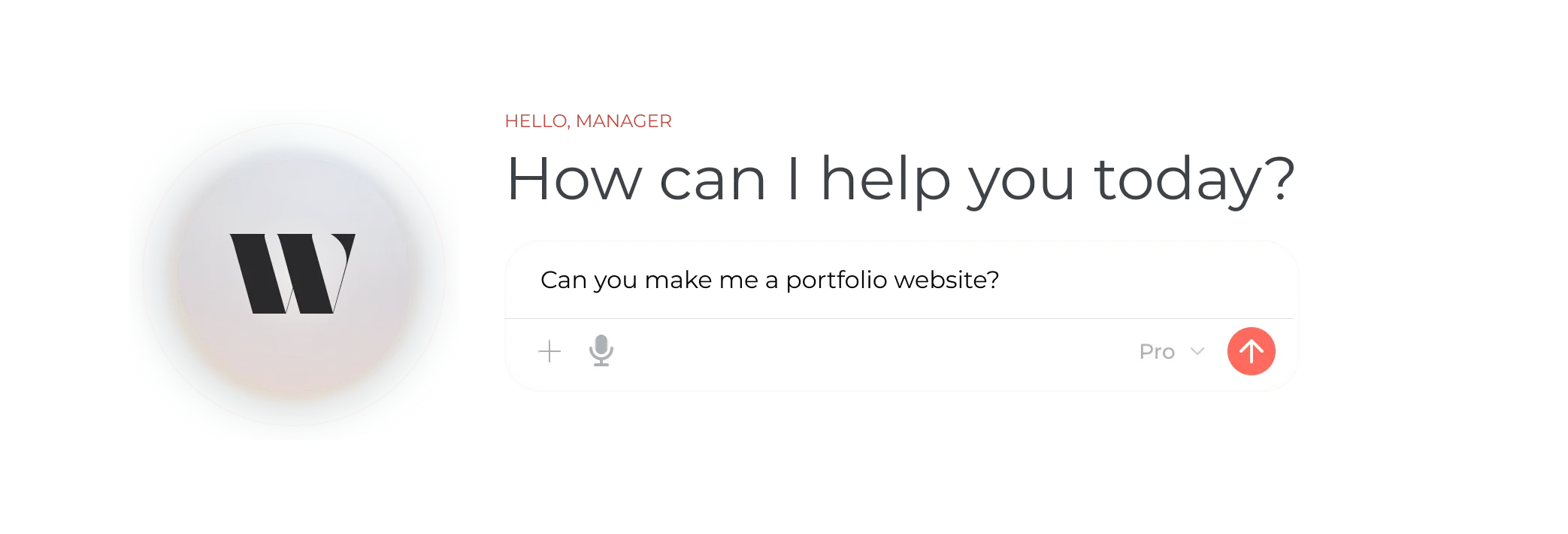
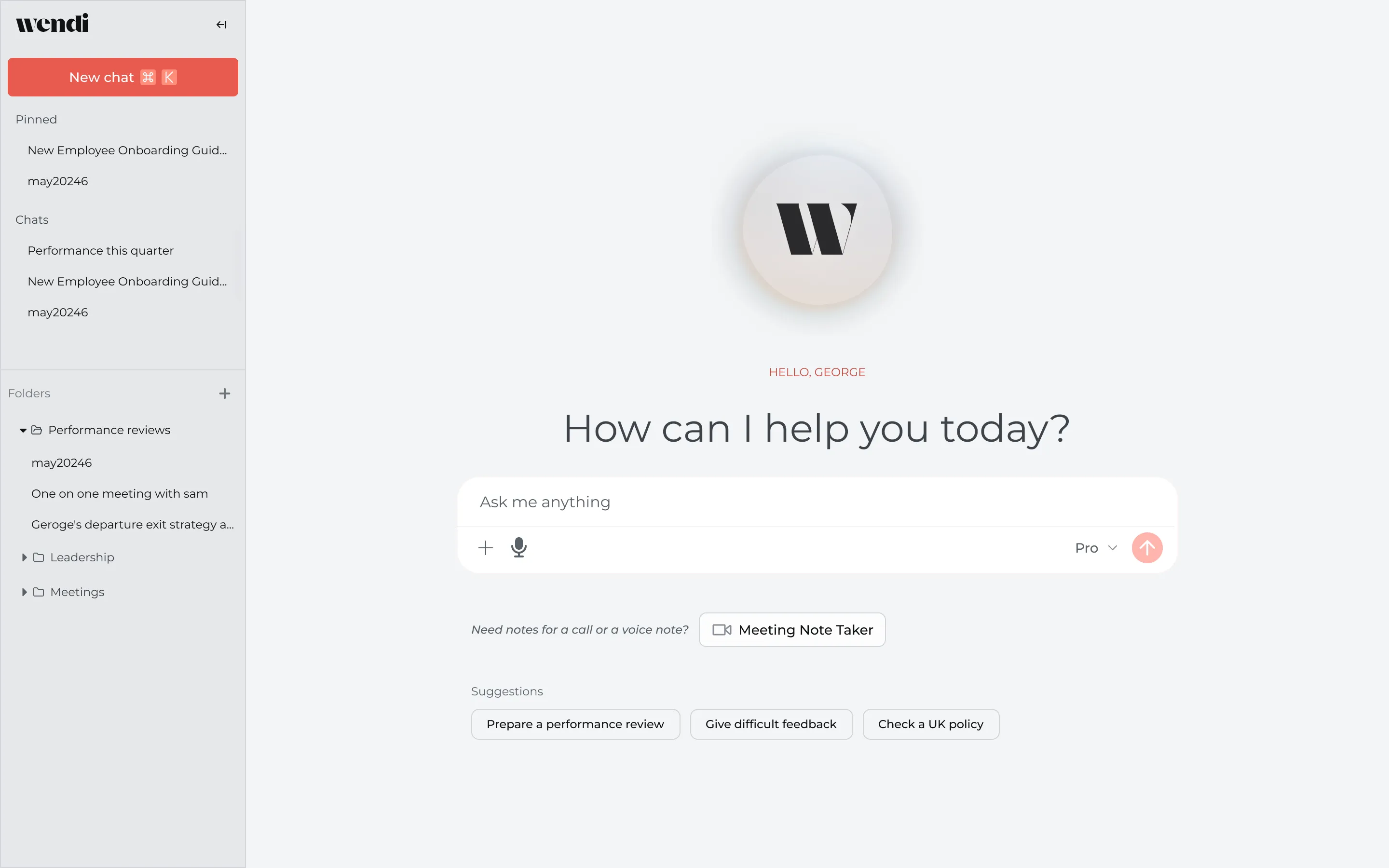
Our first attempt at filling the consultancy gap was a chat interface trained on your policies, your handbook, and your company voice. Two users made it from the landing page to the chat. One asked Wendi to build a portfolio website.
We had the tech, but what we didn’t have was a problem narrow enough to point it at. It wasn’t clear what the product was for - it was designed for any HR situation which meant designed for none. The next versions added new features to the chat interface (meeting recording, topic folders) to try and create differentiation, but none of them narrowed it down.
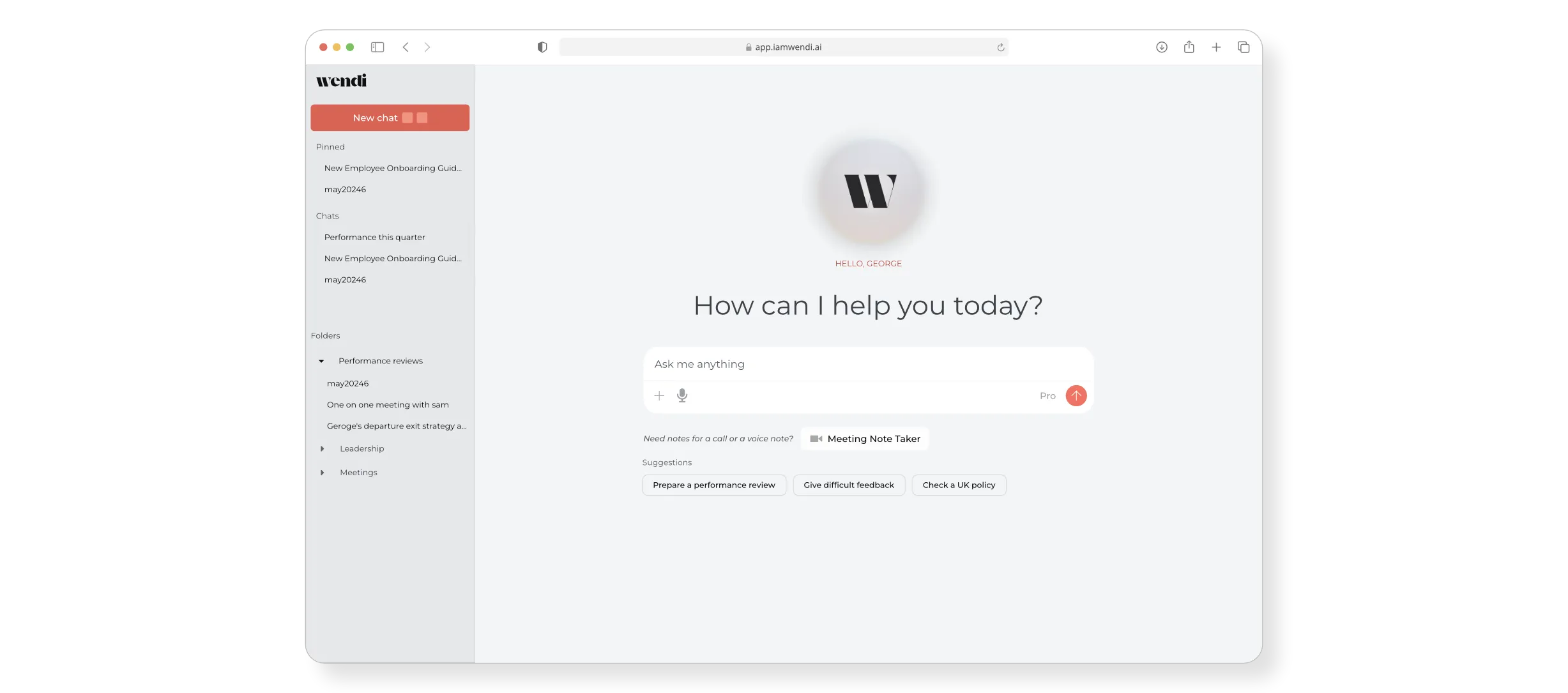
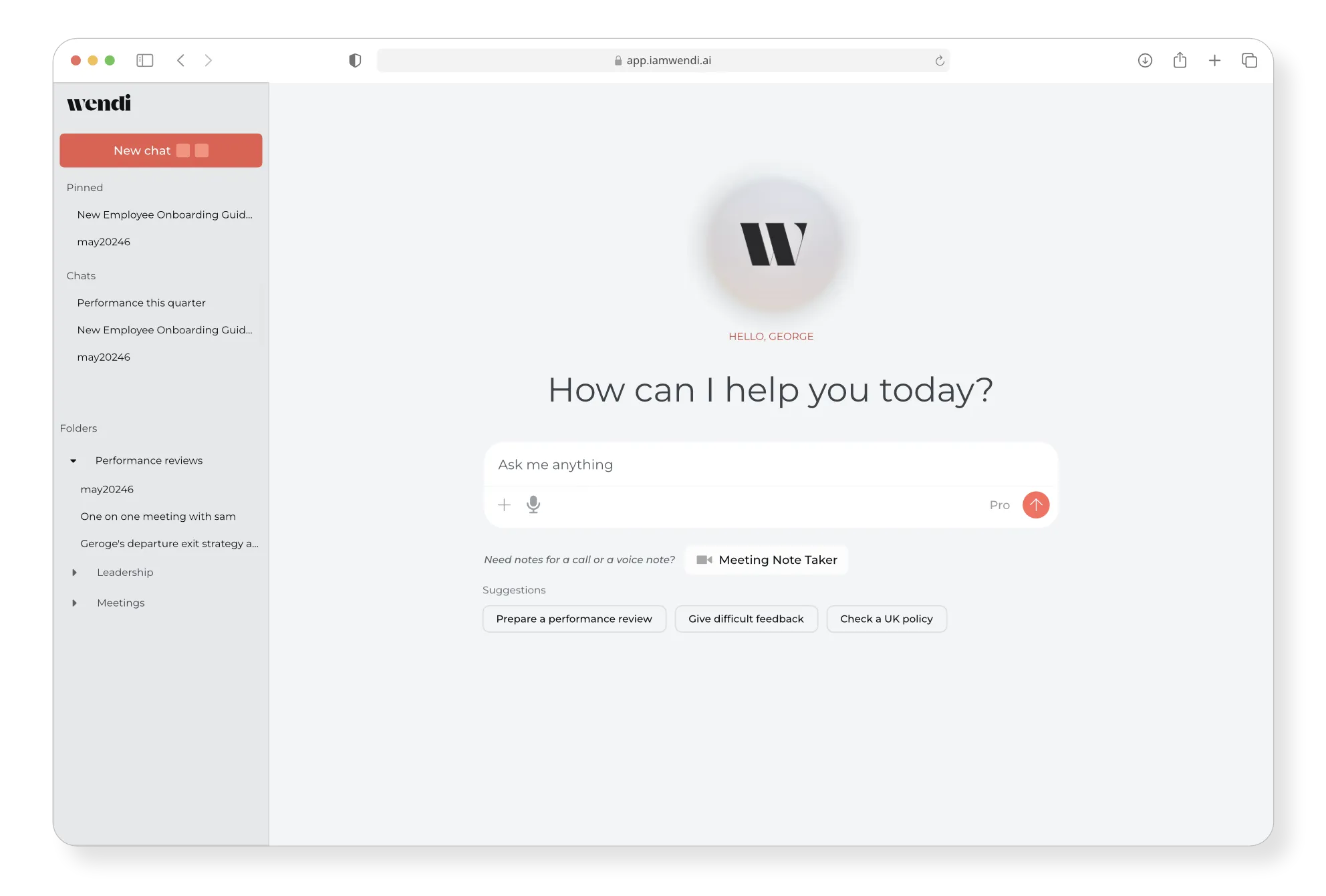
An empty chat box collects anything. We needed to find out what this product
actually was.
Three findings that redirected the product.
40+ interviews while HRIS platforms were shipping AI chatbots.I designed and synthesised the 40+ interviews, with the CEO conducting the interviews. The interview script went through 3 major revisions, getting more narrow than the last.
We started by interviewing anyone in an HR leadership role across companies of different sizes — directors, people partners, HRBPs. Each rewrite came from what the previous round taught us. After script one, the question wasn’t where the pain was — it was who could actually buy a tool that addressed it. After script two, the buyer turned out to be one layer above the end user, and script three followed the user.
Manager pain, broad
Starting hypothesis: ask anyone with people responsibility what eats their week.
Policy vs. coaching
A few rounds in: policy was already being solved everywhere. The real load was coaching — the conversations managers can't outsource.
Who can act
A few rounds in: the HR leaders we'd been interviewing felt the problem but couldn't authorise a fix on their own.
The easy problem everyone was already solving.
Our early finding was that policy questions took up most of an HR manager’s day. HRIS platforms were already building AI chatbots to solve the same problem. But policy questions were repetitive, not hard. The difficult conversations, underperformance, grievances, firing, were less frequent but consumed far more energy.
I asked interviewees to estimate the split between volume and effort across their HR tasks. The numbers were self-reported, but consistent enough across responses to act on:
Every HRIS was racing to ship AI for the loud 70% — the policy questions. The hard 30% (the conversations managers couldn’t outsource) was where the energy actually went, and nobody was building for it. That’s where we placed our bet.
By the time they ask, it’s already bad.
Open door policies aren’t enough.
The shame loop.Almost all our interviewees described situations where no one approached HR until they had to fire someone. Asking HR for help makes the problem official. Managers feel that asking means admitting they can’t handle it, so they wait. By the time they ask, it’s already escalated.
So we asked what actually worked. One HR director told us she changed her strategy from hosting open hours (where no one attended) to scheduling weekly cadence calls with each manager. She caught problems early and coached managers before things escalated.
HR is seen as a cost generating department.
Every business runs on its people, but the department responsible for managing them is seen as a cost centre. Most of the people we spoke to couldn’t sign off on a purchase. Some companies had 3 people in HR across an organisation of 500. Some didn’t have annualised budgets and needed to present cases to the board for approval. What budget existed went to established HR platforms that were also adding AI features.
This finding didn’t redirect what we built. It redirected how we sold it, and what scope we could afford.
The problem was real. But knowing the problem is real doesn’t tell you what to build. HR couldn’t easily buy. The market was crowded with AI tools. The research pointed us away from a general-purpose tool — toward something scoped to one person at a time.
Getting specific on difficult conversations
An interface that's designed to fix everything is designed to fix nothing.I designed V1 to look like ChatGPT on purpose. The technology was unfamiliar to most of our interviewees, and I thought a recognisable interface would lower the barrier. It did, but it also inherited the same problem: a blank input field asks you to already know what you need. Managers are short on time, often promoted without training, responsible for people who are by definition unpredictable. A blank box is one more thing to figure out.
So I went back to the interviews. Most of what we knew about managers came from the HR directors and leaders who coached them. They described the same patterns: managers don’t come with a category in mind. They come with a person and a situation. Tom’s underperforming. Priya’s grievance is escalating. Four actions kept appearing in how HR leaders described helping them.
At the time, we were piling features onto Wendi to differentiate, but nothing made it clearer what Wendi was actually for. We’d become: ChatGPT + AI notetaker.
The verbs reframed it. Chat and meetings weren’t competing features — they were both just inputs. What mattered was distilling them into something designed around how a manager actually works: one person, one situation at a time.
Zeroing in on relationships.
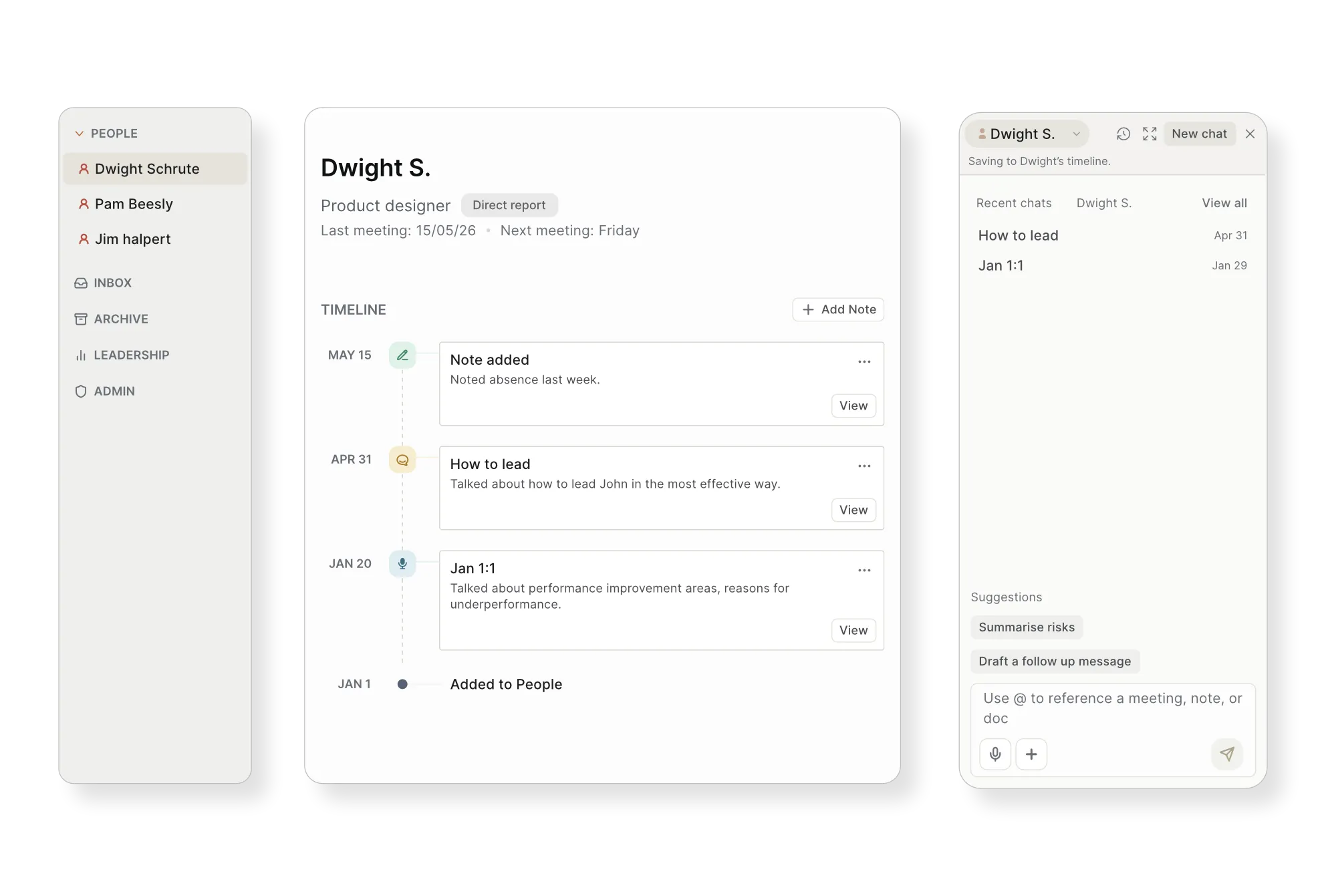
Management is about the relationship with a direct report.People as the home screen.
The team’s initial proposal was a dashboard with management metrics. I pushed back. A manager opens the app thinking “I need to deal with Tom,” not “how many meetings did I have this week.” A dashboard puts something between them and the person they came to deal with. The redesign made direct reports the home screen instead. Fastest path from intent to action.
Timeline as context boundary.
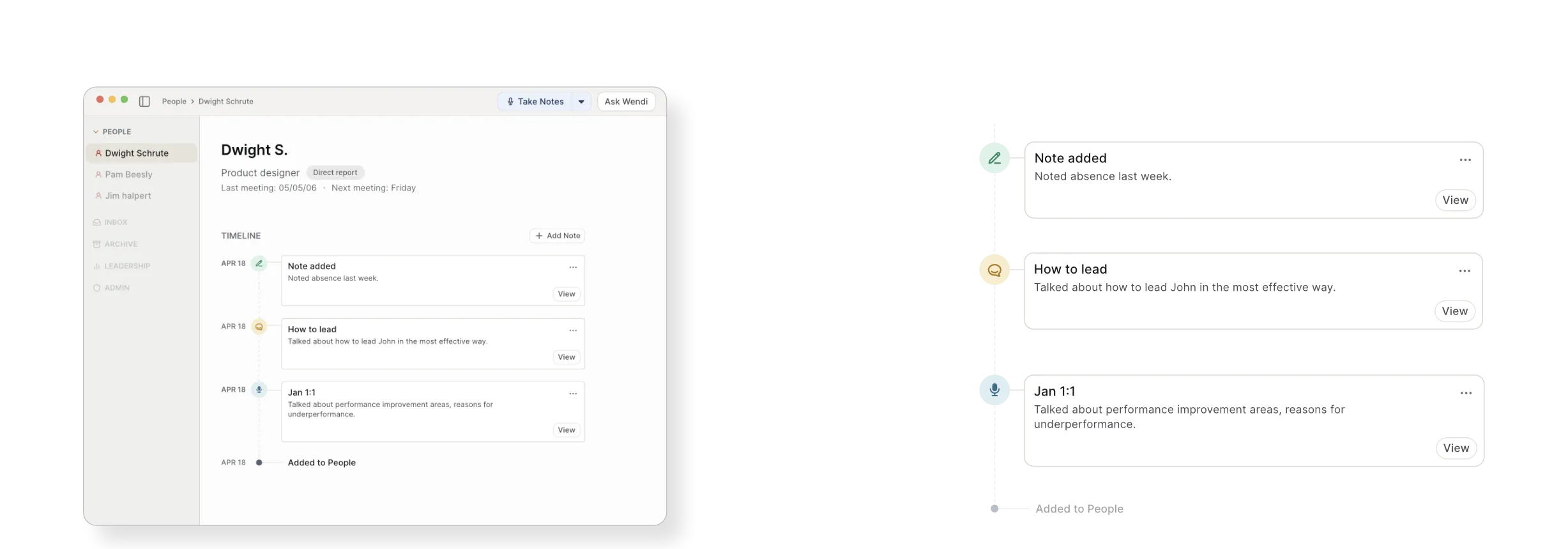
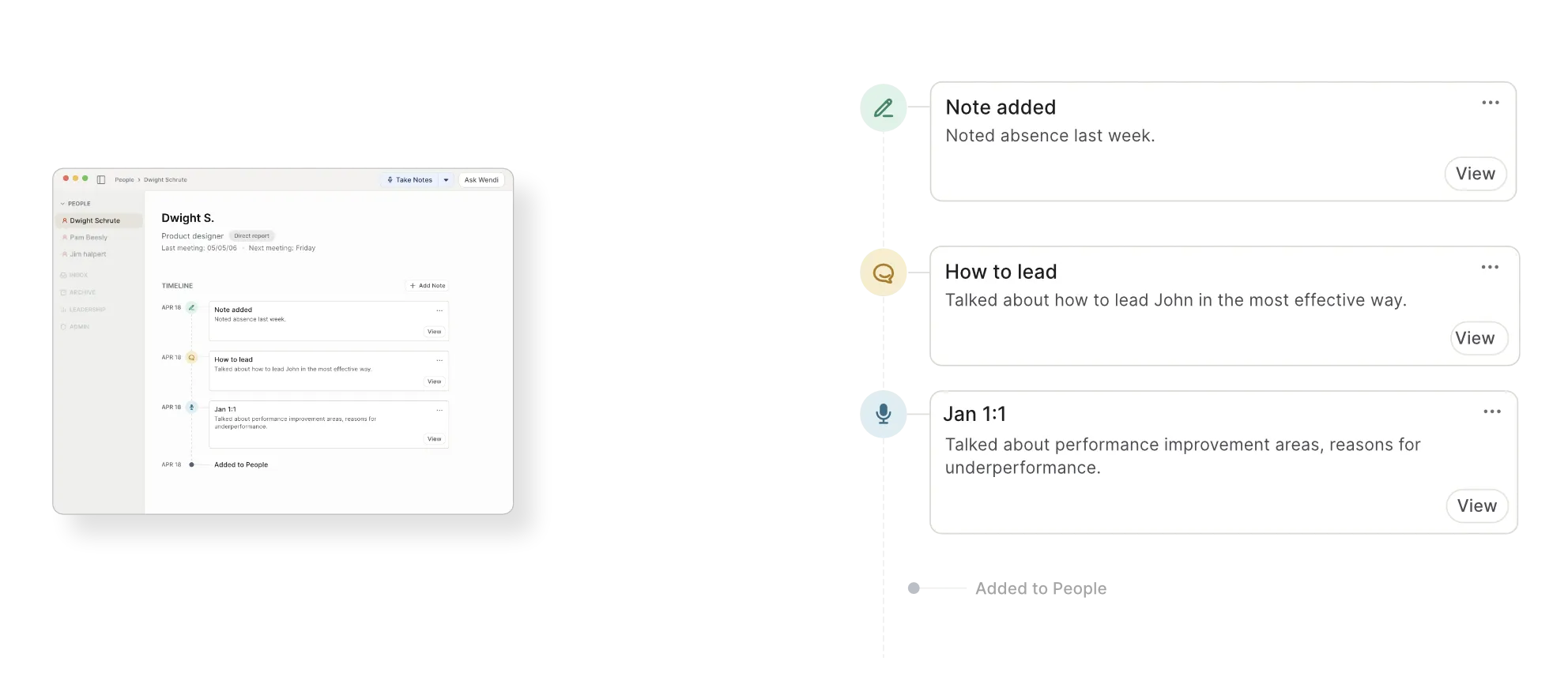
Each relationship gets a timeline: meetings, notes, AI insights, in chronological order. The critical decision wasn’t visual. It was about scope. What sits on a person’s timeline is what Wendi can reference when you ask it about that person.
The timeline is the permission system. If it’s on Tom’s timeline, Wendi can use it in conversation about Tom. If it’s not, Wendi can’t. It’s what a manager can point to if their team asks what the AI does and doesn’t know.
That gave the AI a boundary the user could see and control. It turned out to matter more than any of the privacy copy we’d written.
Inbox and suggestion chips.
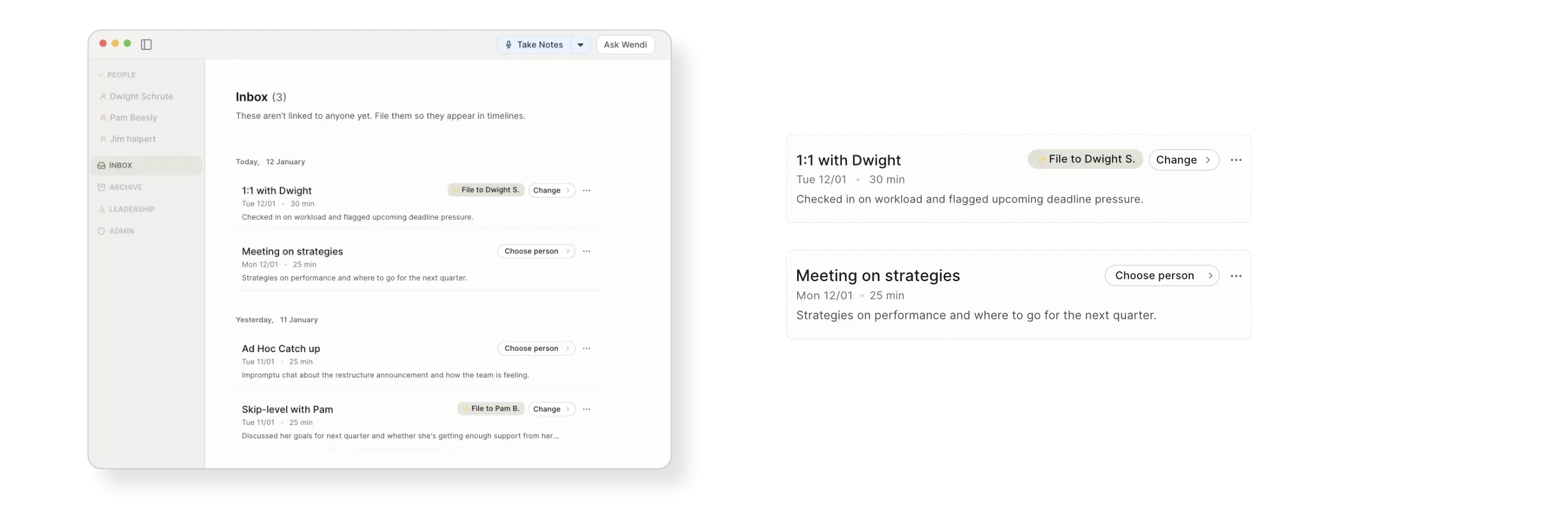
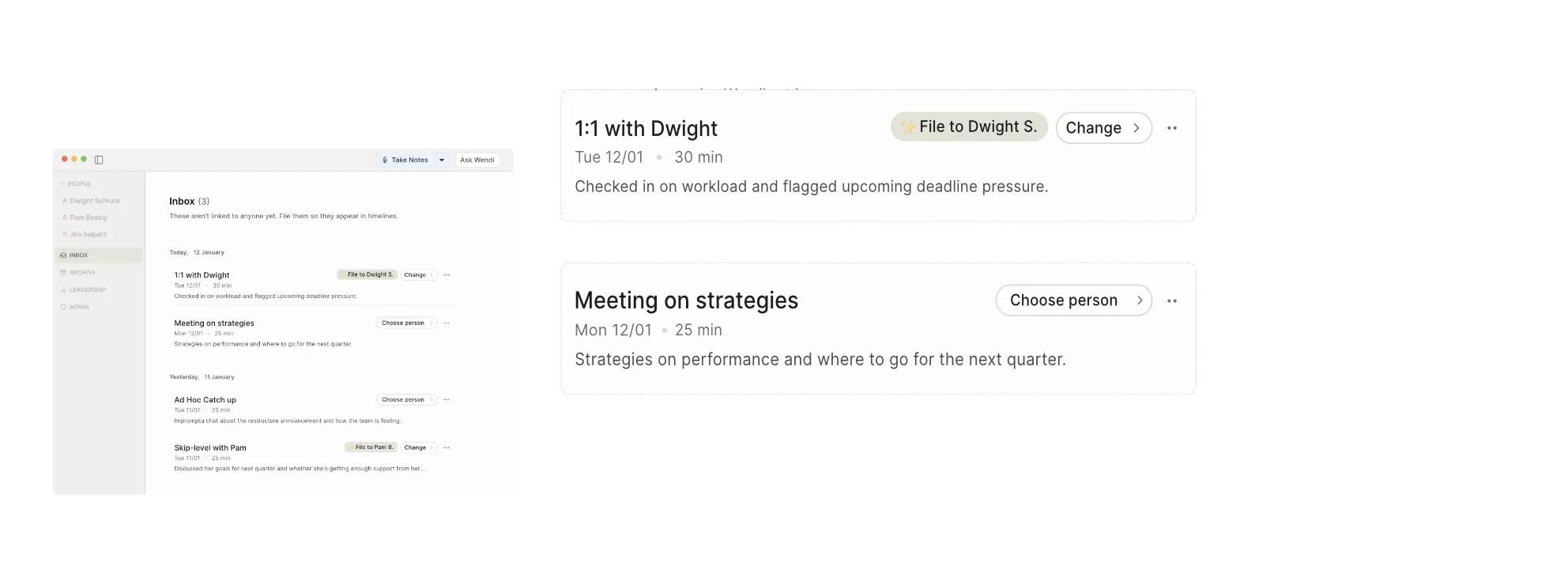
Wendi records meetings automatically, but not every meeting maps neatly to one person. A manager might forget to assign a meeting, or a recording might cover multiple people. Rather than forcing a choice upfront, unassigned items land in the Inbox with suggestion chips.
“This seems like it was with Tom. File to Tom’s timeline?”
The first prototype hard-prompted after each recording. Every design partner dismissed it once and never filed anything. Friction at the wrong moment. Moving the decision to a separate view let people file in batches when they had the attention for it. Without this, “I’ll sort it later” becomes the default and the timeline stops being reliable.
What removal means.
If the timeline is the permission system, then removing something from it isn’t tidying up. It changes what Wendi knows about that person. Removal is an association action, not a deletion action, and UX needed to make that weight felt.
Every feature needed a fallback path. We designed each one so that nothing is lost by accident and every action is reversible.
Escape hatches
Reviewing PostHog session recordings, we found that users accidentally started recordings, couldn’t close the sidebar, and couldn’t find ways to delete items. We tried to map escape hatches to real moments of confusion in the recordings.
From features to people.
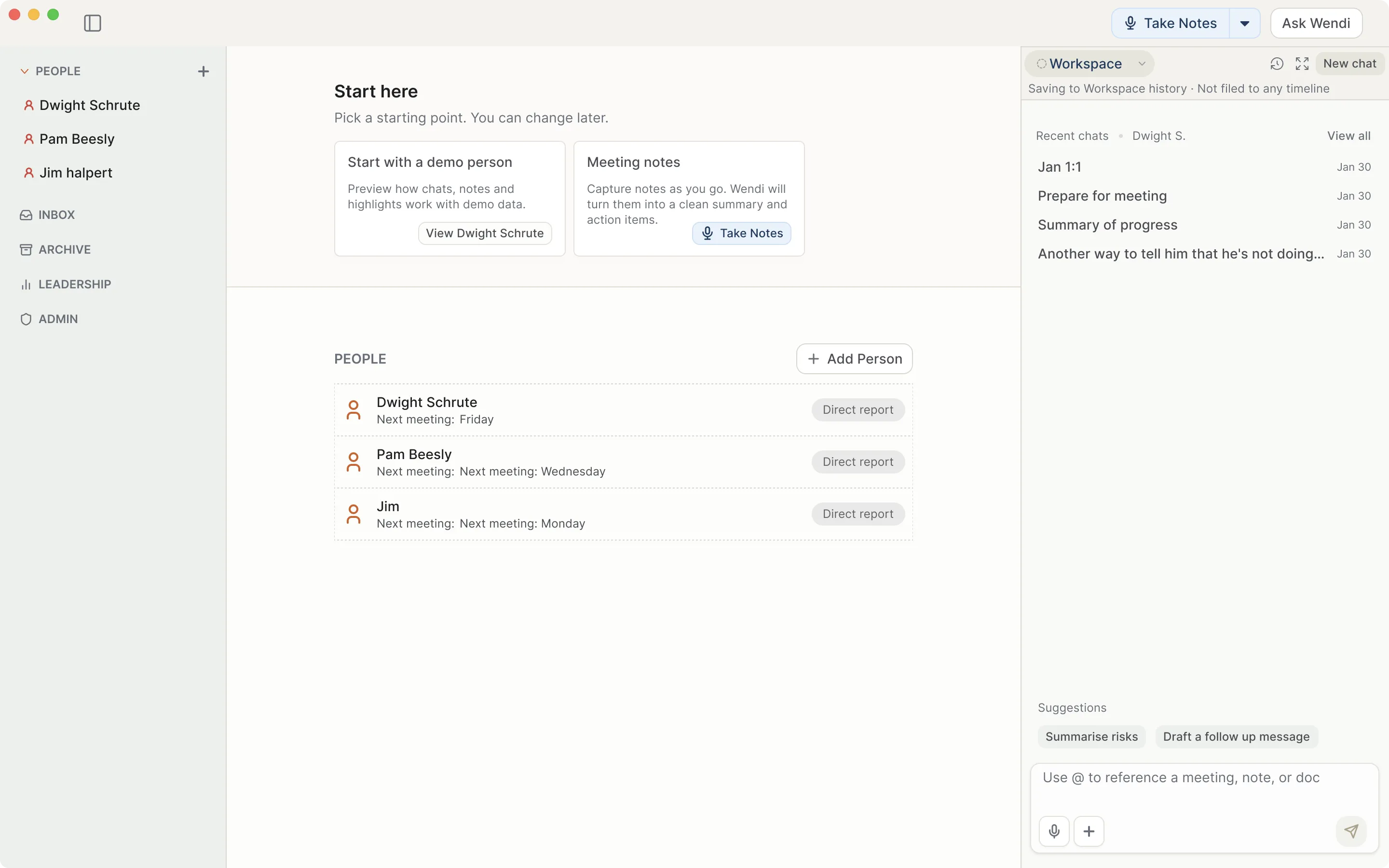
From Dashboard / Chat / Documents / Settings to People / Inbox / Archive.The sidebar is the thesis. Dashboard / Chat / Documents / Settings — each item a feature, nothing a manager would actually say. People / Inbox / Archive — open the app thinking about Tom, and Tom is the first thing you see.
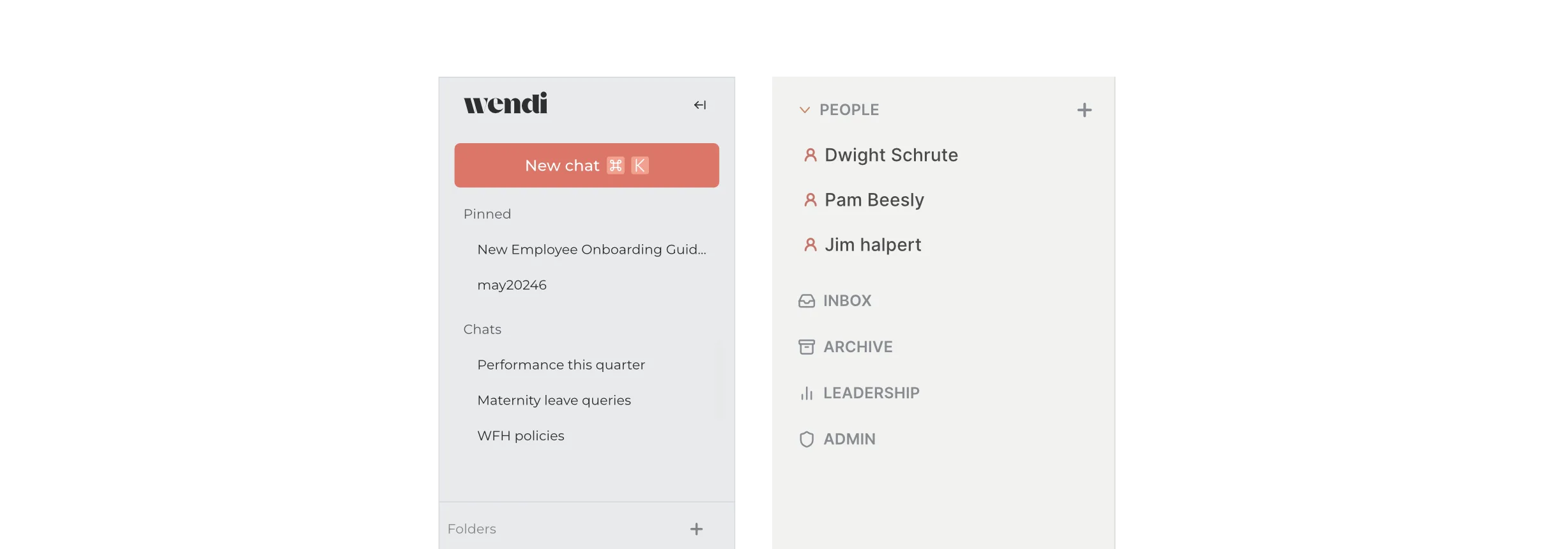
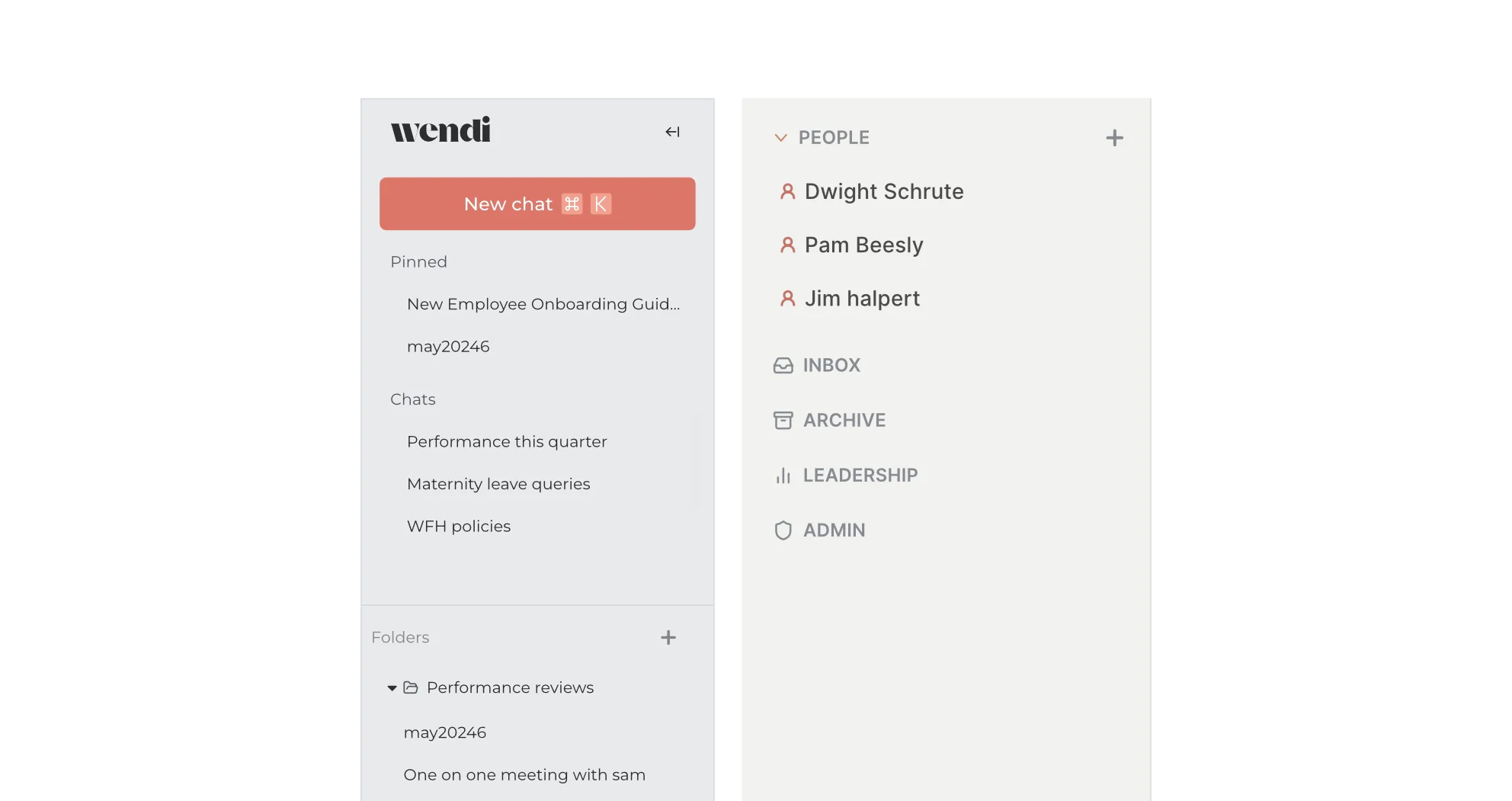
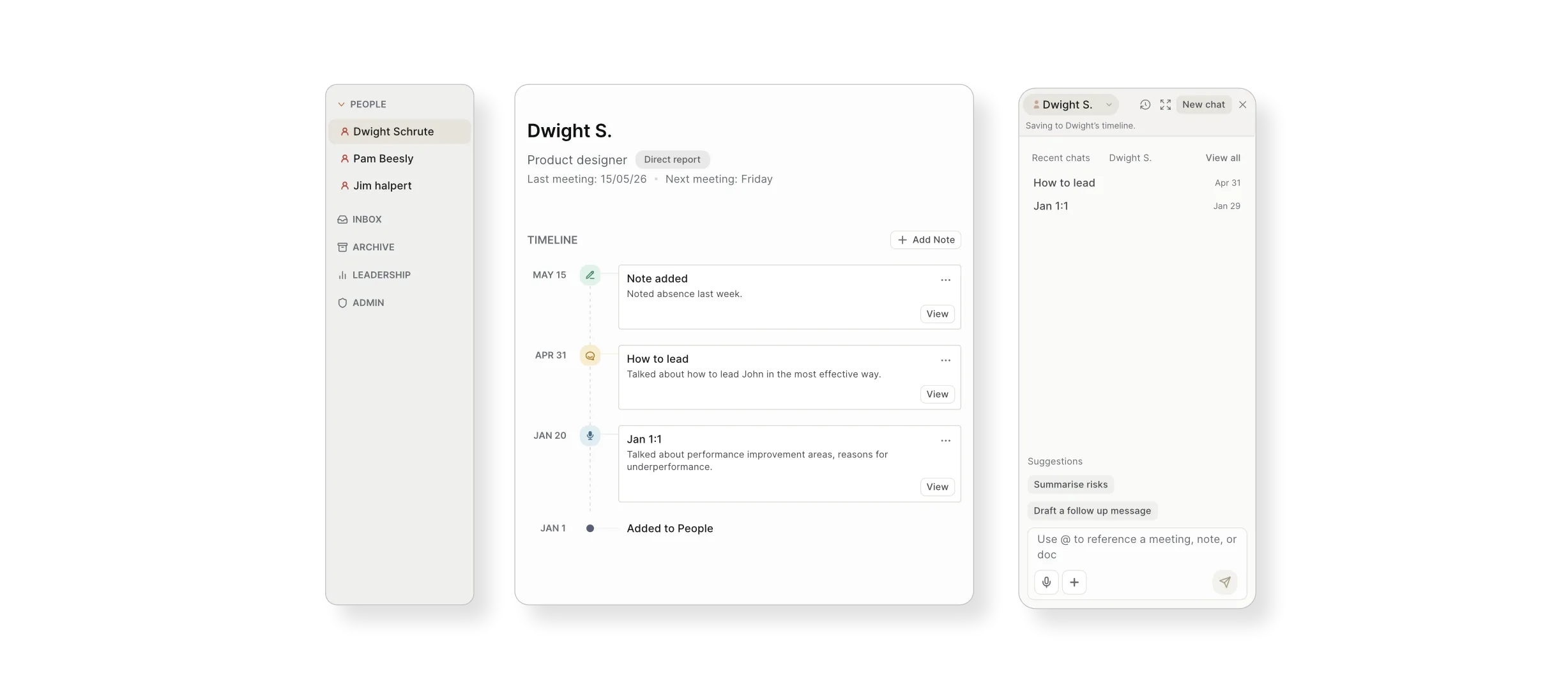
| V1 — Chat | V2 — Folders | V3 — People | |
|---|---|---|---|
| Home | Blank input | Folders | Direct reports |
| Scope | Anything | Topic | One person |
| AI context | None | Folder contents | Person's timeline |
| Ship moment | 2 users reached chat | Shape but no specificity | Two design partners convert |
This redesign actually led to our first paying customers. They use the product daily for real employee relations work. After months of building and pivoting, someone we’d never spoken to directly decided the product was delivering value.
What I'd take forward.
Test the things you can’t see working. The chat panel on the right side of each person’s workspace is the feature I’m least satisfied with. It lets you chat about a specific person with the AI scoped to their timeline. I shipped it without being able to test it with anyone. The interaction behaviour could have been significantly better with even a few usability sessions, but by the time it shipped, there wasn’t time left to iterate.
Disagree with a reason. I pushed back on the dashboard-as-home idea because a manager opens the app thinking about a person, not a metric. I was hesitant to push back early on because I was new to the company. I learned that if you disagree with a reason and invite discussion, you’re more likely to be heard. Being too agreeable is a disservice to the product.
Trust Before Advice→
Setting the rules for AI judgement about how someone led.